

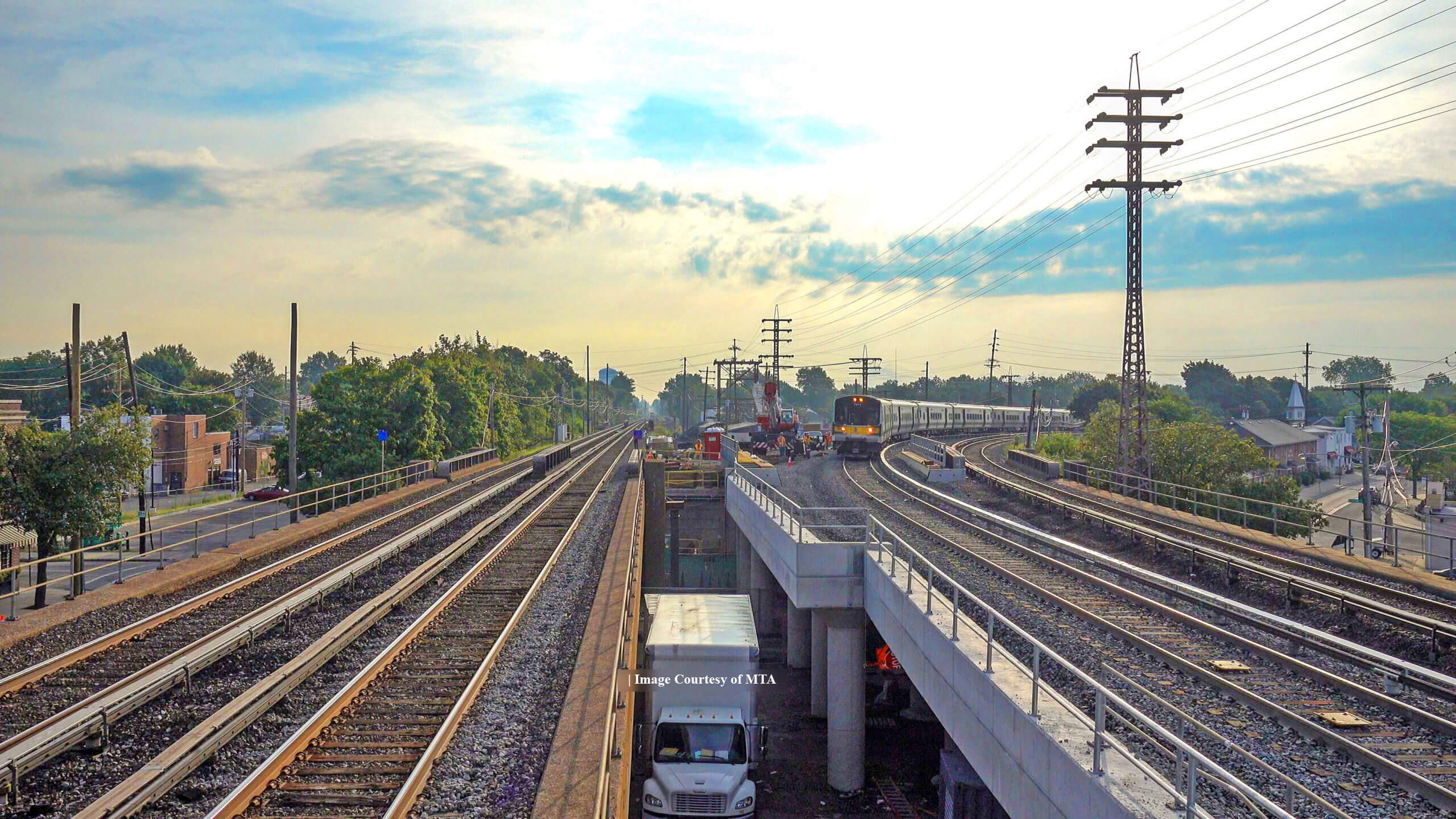
As a subconsultant, SI Engineering, P.C. (SIE) provided project management and construction management for the Long Island Rail Road Mainline Third Track Design-Build Project. This $1.8 billion expansion supported the MTA Long Island Rail Road (the busiest commuter railroad in North America, serving approximately 87 million customers annually). The project consisted of approximately 9.8 miles of additional track infrastructure, including a new 3rd track and associated systems (signals, power, and communications), grade crossing modifications (separations / closures), modification of existing or newly constructed line structures (bridges), station and parking improvements, utility relocations, drainage improvements, substation replacements, installation of new switches, as well as other improvements along the Main Line between Floral Park (Bellerose Interlocking) and Hicksville Station (the Divide Interlocking) in Nassau County.
The project included the elimination of the seven (7) grade crossings along this route, as part of a broader effort that also removed an additional crossing to improve safety and reduce congestion, upgrades to railroad infrastructure and stations, and new parking facilities. This reduced train congestion and delays, and enabled true bi-directional service during peak hours, as well as more intra-Island service. Unlike previous attempts to build a third track on the Main Line, this time, the track was built within the existing LIRR right-of-way. Construction was handled in a way to minimize the impact on daily routines, with extensive mitigation efforts planned in conjunction with local communities. Work also included major station improvements such as renovations at New Hyde Park, Mineola, and Westbury, upgrades at Merillon Avenue and Carle Place, and the addition of six new pedestrian overpasses and fifteen ADA-compliant elevators to increase accessibility. Despite the scale and continuous rail operations, all work was completed without interrupting LIRR service, demonstrating the effectiveness of the project’s complex sequencing and execution.
The end result is a Long Island with better rail service, safer, less-congested roads, cleaner air, quieter backyards and neighborhoods, and a public transit infrastructure better equipped to serve the job and population growth our region needs to prosper.
